Academic Papers
LaTeX research paper template
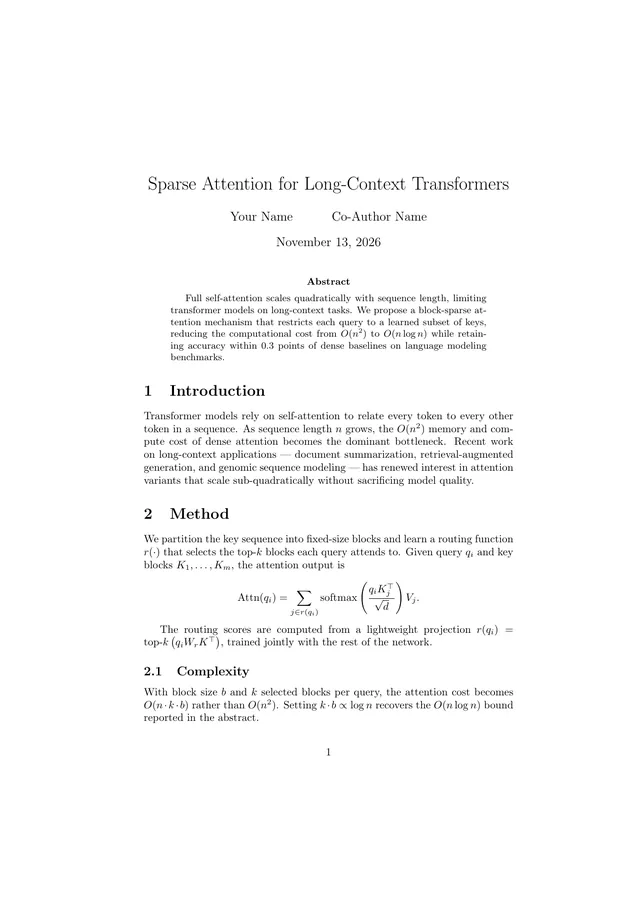
A general-purpose article paper with a title block, abstract, Introduction, Method with display equations, Results with a table, and references. This is the template TeXpad opens with, and the quickest way to start a paper.
Open in TeXpad, no signup → Download example PDF
Free · real pdfTeX in your browser · works offline · your files stay on your device
Who it's for
A neutral starting point for any paper. For a venue-style CS submission, use the conference paper. For a journal manuscript with keywords and Materials and Methods, use the journal article. For a short theorem-proof note, use the arXiv preprint.
How to customize this template
- Set
\titleand\author. Separate co-authors with\and. - Write the abstract last. Keep it to one paragraph with the main number in it.
- Number the equations you refer to with
\begin{equation}…\label{…}. - Add citations in a
thebibliographyblock, or import a.bibfile from the Import menu.
When it looks right, press Download PDF. To take the .tex to Overleaf or a local TeX install, choose Export → LaTeX source.
The first lines of the source
\documentclass{article}
\usepackage{amsmath}

\title{Sparse Attention for Long-Context Transformers}
\author{Your Name \and Co-Author Name}
\date{\today}

\begin{document}
\maketitle

\begin{abstract}
Full self-attention scales quadratically with sequence length, limiting transformer models on long-context tasks. We propose a block-sparse attention mechanism that restricts each query to a learned subset of keys, reducing the computational cost from $O(n^2)$ to $O(n \log n)$ while retaining accuracy within 0.3 points of dense baselines on language modeling benchmarks.
\end{abstract}

\section{Introduction}
Transformer models rely on self-attention to relate every token to every other token in a sequence. As sequence length $n$ grows, the $O(n^2)$ memory and compute cost of dense attention becomes the dominant bottleneck. Recent work on long-context applications --- document summarization, retrieval-augmented generation, and genomic sequence modeling --- has renewed interest in attention variants that scale sub-quadratically without sacrificing model quality.

\section{Method}
…Related templates
Free LaTeX tools
- Online LaTeX compiler: paste a .tex file and get the PDF
- Import an Overleaf project: open a project zip, nothing uploaded
- LaTeX symbols cheat sheet: every common command, with a printable PDF
- LaTeX to PDF converter: drop a .tex, download a PDF