Academic Papers
LaTeX journal article template
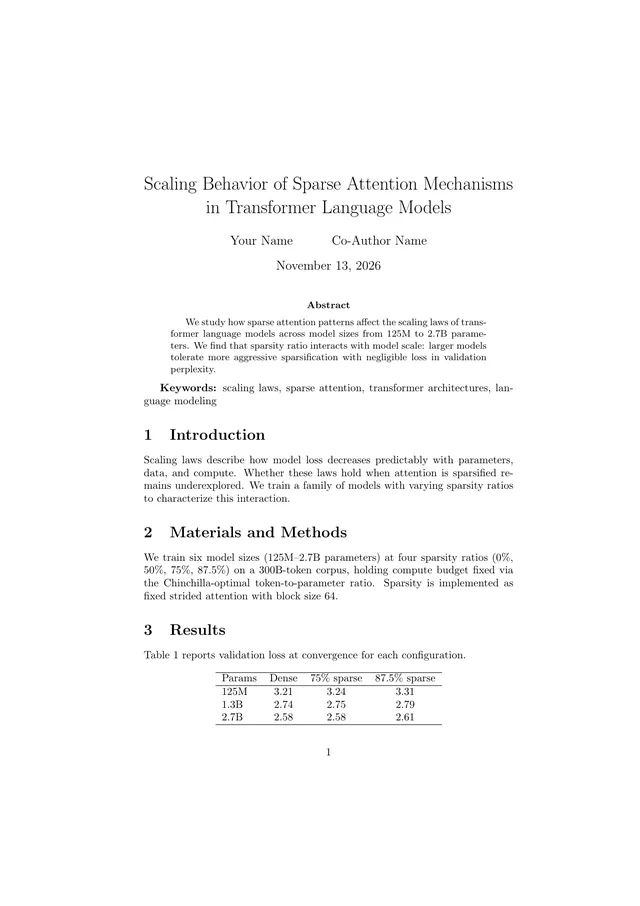
A manuscript in the IMRaD structure most journals ask for: Introduction, Materials and Methods, Results, Discussion, and Conclusion, plus abstract and keywords. Use it to prepare a submission or a cover-letter-ready draft.
Open in TeXpad, no signup → Download example PDF
Free · real pdfTeX in your browser · works offline · your files stay on your device
Who it's for
For journal submissions that follow IMRaD. Conference drafts and short notes have their own templates.
How to customize this template
- Check the journal's author guidelines for word and figure limits before you start.
- Write Materials and Methods so that someone else could reproduce the work.
- Keep interpretation in Discussion and keep Results factual.
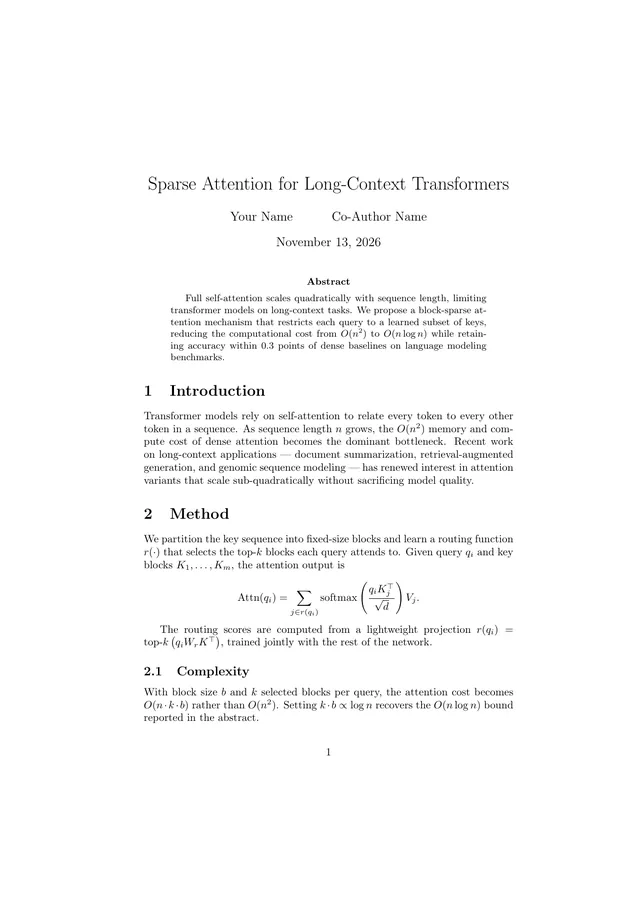
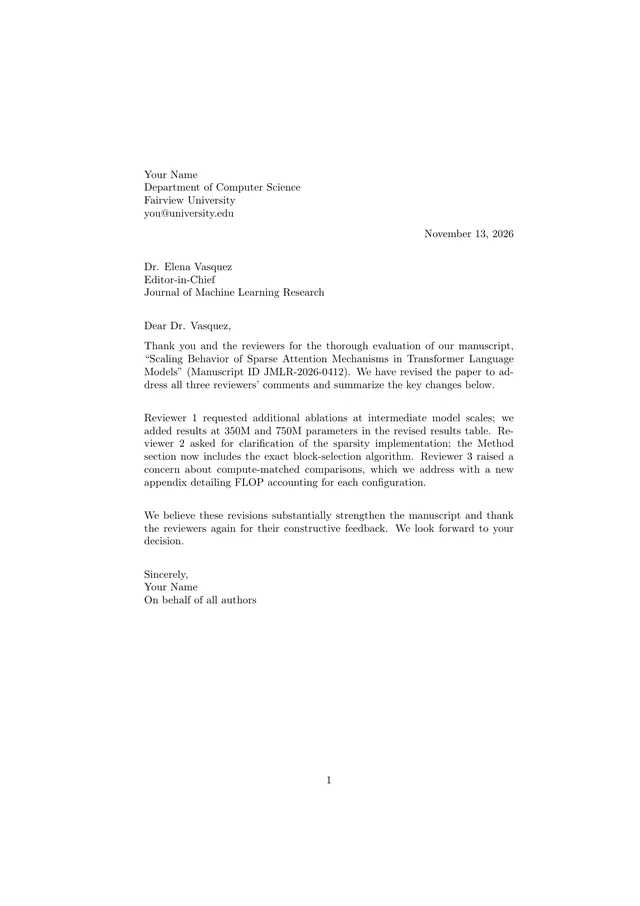
- Pair it with the formal letter template for the submission cover letter to the editor.
When it looks right, press Download PDF. To take the .tex to Overleaf or a local TeX install, choose Export → LaTeX source.
The first lines of the source
\documentclass{article}
\usepackage{amsmath}

\title{Scaling Behavior of Sparse Attention Mechanisms in Transformer Language Models}
\author{Your Name \and Co-Author Name}
\date{\today}

\begin{document}
\maketitle

\begin{abstract}
We study how sparse attention patterns affect the scaling laws of transformer language models across model sizes from 125M to 2.7B parameters. We find that sparsity ratio interacts with model scale: larger models tolerate more aggressive sparsification with negligible loss in validation perplexity.
\end{abstract}

\textbf{Keywords:} scaling laws, sparse attention, transformer architectures, language modeling

\section{Introduction}
Scaling laws describe how model loss decreases predictably with parameters, data, and compute. Whether these laws hold when attention is sparsified remains underexplored. We train a family of models with varying sparsity ratios to characterize this interaction.
…Related templates
Free LaTeX tools
- Online LaTeX compiler: paste a .tex file and get the PDF
- Import an Overleaf project: open a project zip, nothing uploaded
- LaTeX symbols cheat sheet: every common command, with a printable PDF
- LaTeX to PDF converter: drop a .tex, download a PDF